


 ahsan
ahsan Every successful trader knows that mastering indicators or fancy tools isn’t the secret to consistent profits — the real power lies in understanding market structure. Market structure is the foundation of all price movement. It tells the story of how buyers and sellers interact, how trends are formed, and where reversals begin.
Whether you trade forex, stocks, crypto, or commodities, understanding how the market moves is the first step toward professional trading. Without this knowledge, every trade is just a guess. But when you learn to read the structure of the market, you begin to see patterns, identify opportunities, and make decisions based on logic — not emotion.
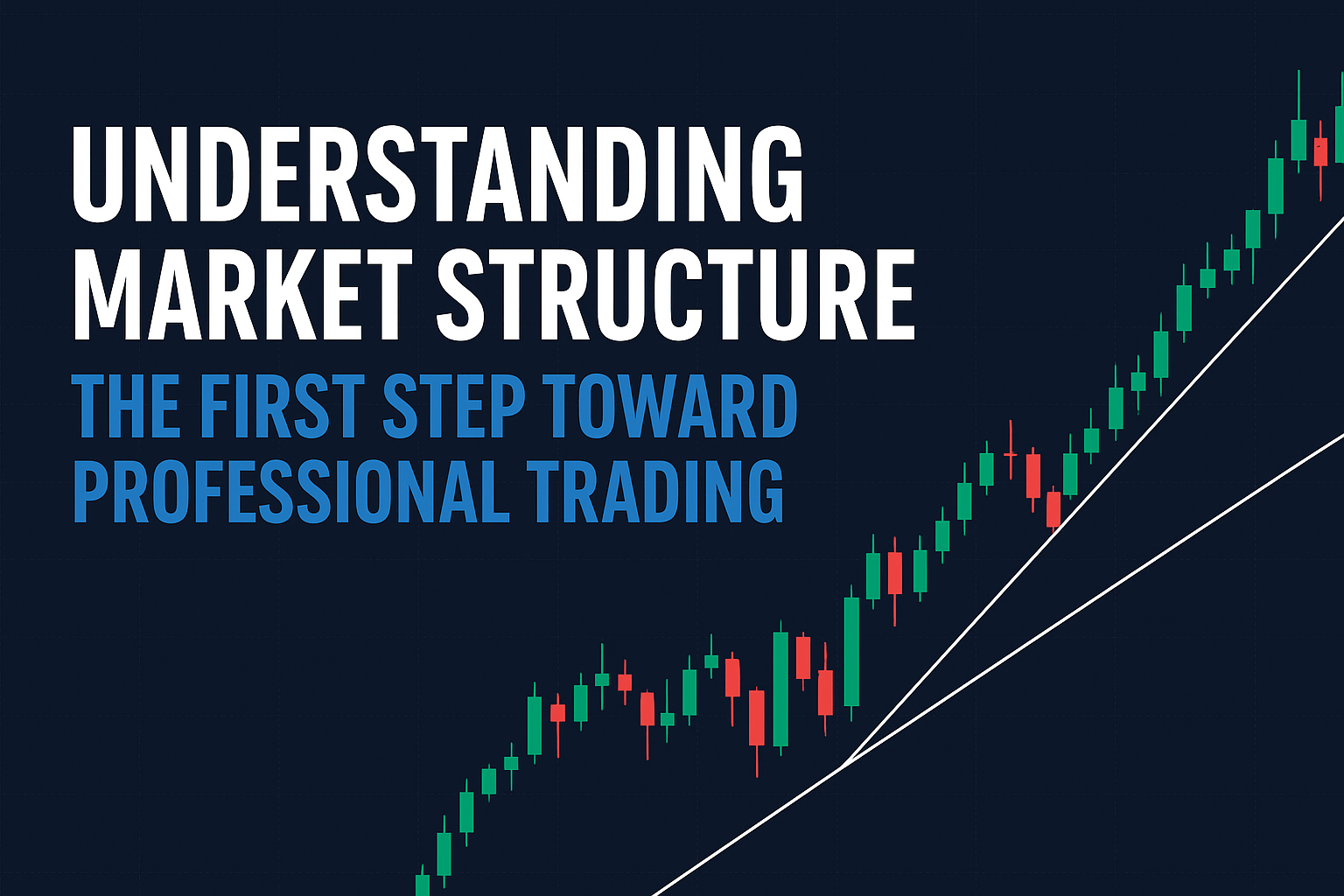
Understanding Market Structure: The First Step Toward Professional Trading
Every professional trader started as a beginner who learned how the market truly works. Before mastering indicators, strategies, or psychology, the most important foundation in trading is understanding market structure. Market structure is what reveals the logic behind every price movement — it shows how and why prices rise, fall, or move sideways.
Whether you trade forex, stocks, commodities, or cryptocurrencies, every financial market operates under similar structural principles. Once you learn to recognize these structures, you’ll stop guessing and start reading the market like a professional.
This article will help you understand what market structure is, how to identify it, why it’s so important, and how mastering it can turn you from a struggling trader into a confident, consistent one.
What is Market Structure?
Market structure refers to how price moves in patterns over time. The market never moves randomly — it follows a cycle of highs and lows that form identifiable structures. These structures tell traders where the price is heading, when the market is trending, and when it is ranging.
In simple words:
Market Structure = The natural flow of price movement on a chart.
Every move in the market consists of two key elements:
-
Impulsive Moves (Strong direction moves) – when price pushes with strong momentum.
-
Corrective Moves (Pullbacks or retracements) – when price temporarily moves against the main direction.
By analyzing these moves, traders can identify whether the market is in an uptrend, downtrend, or sideways phase.
The Three Main Types of Market Structure
Understanding the type of market you’re in helps you decide how to trade. There are three main types:
1. Uptrend (Bullish Structure)
An uptrend occurs when the market creates higher highs (HH) and higher lows (HL).
This pattern shows that buyers are in control and pushing prices upward.
Example:
-
Price goes from 1.1000 → 1.1200 (new higher high)
-
Then retraces to 1.1100 (higher low)
-
Then rises again to 1.1300 (another higher high)
This continuous pattern of HH and HL signals a bullish structure. Traders look for buy opportunities during retracements.
2. Downtrend (Bearish Structure)
A downtrend is the opposite of an uptrend. Here, the market forms lower highs (LH) and lower lows (LL), showing that sellers are dominating.
Example:
-
Price drops from 1.3000 → 1.2800 (new lower low)
-
Retraces to 1.2900 (lower high)
-
Then drops again to 1.2700 (another lower low)
This pattern shows a bearish structure. Traders look for sell opportunities on pullbacks.
3. Range (Sideways Structure)
Sometimes, the market doesn’t trend at all. Instead, it moves between a support level (bottom) and a resistance level (top).
This phase is called consolidation or ranging market.
In this structure, neither buyers nor sellers have full control. Traders often wait for a breakout before entering new trades.
Why Understanding Market Structure is Important
Market structure is the foundation of all trading decisions.
Here’s why every professional trader starts with it:
-
Helps Identify Trends and Reversals
You can easily see when a trend is beginning or ending. -
Guides Entry and Exit Points
Knowing structure helps you decide where to buy or sell for maximum profit. -
Improves Risk Management
You can set stop-losses below swing lows or highs based on structure. -
Reduces Emotional Trading
Structure gives clarity and removes guesswork. -
Simplifies Analysis
Even without indicators, structure shows you what’s really happening in the market.
Professional traders read price structure first, then use indicators for confirmation — not the other way around.
How to Read and Identify Market Structure
To understand market structure, you must learn how to read swing highs and swing lows — the turning points in price.
1. Identify Swing Highs and Swing Lows
-
A swing high forms when price peaks before reversing downward.
-
A swing low forms when price bottoms before reversing upward.
These swings connect to form the overall structure.
2. Recognize Break of Structure (BOS)
A Break of Structure happens when price breaks past a previous swing high or swing low.
This signals a potential change in trend direction.
-
If price breaks a higher high, the market remains bullish.
-
If price breaks a lower low, the market may turn bearish.
3. Use Higher Timeframes
Market structure is best understood when you analyze higher timeframes (Daily, 4H).
The bigger the timeframe, the more reliable the structure.
After identifying the main direction on higher timeframes, you can refine entries on lower timeframes like 1H or 15M.
4. Understand Internal and External Structure
-
External Structure: The larger, more visible market trend.
-
Internal Structure: The smaller fluctuations within that trend.
Professionals analyze both to catch early trend reversals or continuation moves.
Market Structure Phases
Every market goes through four major phases repeatedly. Understanding these helps you stay ahead of price movement.
1. Accumulation Phase
This is where smart money (institutions) start buying or selling quietly after a large move.
Price moves in a tight range with little direction. It’s a sign that a new trend may be forming.
2. Manipulation Phase
Here, big players create false breakouts to trap retail traders.
For example, price breaks above resistance to trigger buy orders, then quickly reverses to the downside.
3. Expansion Phase
The trend becomes strong and clear. This is when most traders enter the market, and price moves aggressively in one direction.
4. Distribution Phase
The trend begins to slow down as smart money exits their positions.
After distribution, the market usually enters a new accumulation phase again — and the cycle repeats.
Market Structure and Smart Money Concepts (SMC)
Professional traders follow Smart Money Concepts, which are advanced techniques to read how institutions move the market.
They focus on liquidity, order blocks, and market structure shifts.
1. Liquidity
Liquidity represents the pool of pending orders (stop-losses and take-profits).
Institutions often move price toward these zones to collect liquidity before changing direction.
2. Order Blocks
An order block is the last bullish or bearish candle before a major market move.
These zones act as key areas of interest where institutional orders exist.
3. Change of Character (CHOCH)
A CHOCH signals the first sign of a trend reversal — when price breaks structure in the opposite direction.
Combining these concepts with market structure helps you understand the true behavior of price action.
Market Structure and Timeframes
One mistake many beginners make is focusing only on one timeframe.
But professionals use multi-timeframe analysis:
-
Higher Timeframe (HTF): Defines the main market direction (Daily, 4H).
-
Middle Timeframe (MTF): Confirms structure (1H).
-
Lower Timeframe (LTF): Refines entries and exits (15M, 5M).
Example:
-
On the Daily chart, you spot a bullish structure.
-
On 1H, you wait for a retracement (pullback).
-
On 15M, you find your entry at a BOS or CHOCH.
This method increases accuracy and confidence.
How to Build a Trading Strategy Using Market Structure
Once you understand market structure, you can build a simple and powerful trading plan.
Step 1: Determine the Market Direction
Use higher timeframes to identify if the market is bullish, bearish, or ranging.
Step 2: Wait for a Pullback
After an impulsive move, wait for the market to retrace and form a higher low (HL) or lower high (LH).
Step 3: Enter After Confirmation
Look for:
-
Break of structure (BOS)
-
Candlestick patterns like engulfing or pin bars
-
Liquidity sweeps near key levels
Step 4: Set Stop Loss and Take Profit
Always set your stop loss below or above the last swing point.
Target a minimum of 1:2 or 1:3 risk-to-reward ratio.
Step 5: Manage Trades Professionally
Move your stop loss to break even after price moves in your favor, and take partial profits when possible.
Common Mistakes Traders Make with Market Structure
Even though market structure is simple, many traders struggle with it due to these common mistakes:
-
Ignoring higher timeframes
-
Forcing trades against the trend
-
Confusing retracements with reversals
-
Using too many indicators
-
Lack of patience for confirmation
-
Not keeping charts clean and simple
Remember, simplicity = clarity = consistency.
Practical Example: Analyzing Market Structure
Let’s say you open the EUR/USD 4-hour chart:
-
You notice price has been making higher highs and higher lows — bullish structure.
-
Price retraces and forms a higher low near a support zone.
-
You see a bullish engulfing candle followed by a break of structure to the upside.
-
You enter a buy trade with a stop loss below the last higher low.
-
Price continues upward — you ride the trend and secure profits.
This simple yet powerful approach comes entirely from reading market structure, no complicated indicators needed.
Market Structure and Price Action: The Perfect Combination
Market structure provides the framework; price action provides the confirmation.
Together, they create a powerful trading strategy.
For example:
-
Structure shows you the direction.
-
Price action tells you when to enter.
-
Liquidity helps you understand why price is moving.
By combining these elements, you’ll trade like a professional — calm, confident, and strategic.
Tips to Master Market Structure
Here are some professional tips to help you master this concept faster:
-
Use naked charts — remove indicators and study raw price.
-
Mark swing highs and lows daily.
-
Analyze multiple timeframes.
-
Keep a trading journal.
-
Focus on quality setups, not quantity.
-
Understand liquidity and smart money concepts.
-
Be patient and consistent — mastery takes time.
Frequently Asked Questions
1. What is market structure in trading?
Market structure refers to how price moves in patterns of highs and lows over time. It helps traders understand whether the market is trending upward, downward, or moving sideways. In simple terms, it shows how buyers and sellers control price movement.
2. Why is understanding market structure important for traders?
Understanding market structure allows traders to identify trends, reversals, and consolidation phases. It helps them find better entry and exit points, manage risk effectively, and trade with more confidence instead of guessing.
3. What are the three main types of market structure?
The three main types are:
-
Uptrend (Bullish): Higher highs and higher lows.
-
Downtrend (Bearish): Lower highs and lower lows.
-
Range (Sideways): Price moves between support and resistance levels.
4. How can I identify market structure on a chart?
To identify market structure, look for swing highs and swing lows on the chart.
-
If price forms higher highs and higher lows → the market is bullish.
-
If price forms lower highs and lower lows → the market is bearish.
-
If price stays between equal highs and lows → the market is ranging.
5. What is a break of structure (BOS)?
A Break of Structure (BOS) happens when price breaks above a previous high or below a previous low.
-
A break above a high signals bullish continuation.
-
A break below a low signals bearish momentum.
It’s one of the most reliable signs of a trend change.
6. How do professional traders use market structure?
Professional traders use market structure to align their trades with the market’s direction. They combine it with price action, liquidity zones, and smart money concepts to make informed trading decisions with minimal risk.
7. Can market structure be used in all markets?
Yes. Market structure works in forex, crypto, stocks, indices, and commodities. The patterns of price movement are universal, no matter the asset or timeframe.
8. What’s the difference between market structure and price action?
Market structure shows the overall flow and direction of price.
Price action focuses on how price behaves within that structure — such as candlestick patterns and reactions at key levels.
Together, they form a complete trading approach.
9. What is the best timeframe to study market structure?
There’s no single “best” timeframe — it depends on your trading style:
-
Swing traders: 4-hour or daily charts.
-
Day traders: 1-hour or 15-minute charts.
-
Scalpers: 5-minute or 1-minute charts.
It’s best to start your analysis on a higher timeframe and refine entries on a lower one.
10. Can beginners learn market structure easily?
Absolutely. Market structure is one of the easiest and most effective trading concepts to learn. With consistent practice and chart study, even beginners can quickly understand how trends and reversals form.
Conclusion
Understanding market structure truly is the first step toward professional trading. It gives you the ability to read price action clearly, anticipate market movements, and trade with logic rather than emotion.
Once you master this foundation, every other concept — like liquidity, order blocks, or indicators — will make more sense.
You’ll start to see what most traders can’t: the hidden logic behind every price movement.
So take your time, study the charts daily, and focus on market structure until it becomes second nature.
Because in trading, those who understand structure understand the market itself.
want to read more about trading click here
Big Shoutout to the guys who made this blog happen UDM.